
After Sitting Too Long
What Does Your Body Say?

You’ve been sitting at your desk. Your eyes focus on your computer’s screen. You’re analyzing a data set, coaxing out your next sentence, perhaps begging, silently, for a crucial response to your e-mail.
You stand up.
What does your body say?
Most of us don’t wait for the answer.
What if you invited curiosity into your body instead of pushing through it?
Perhaps your low back spasms, your shoulders tighten, or your neck quietly reminds you of the pain you had been ignoring. Over the years, your body has gotten louder and more insistent.
It might not be work. Maybe it’s pickleball. You’re dying to play well – all your friends are into it. So you keep going. But then your body begins talking to you.
You shake off this familiar response. You’ve moved on with a quick stretch or a peek at your phone.
You Do Something
You push through. You are in what I call “do mode.” You’re a problem solver. You’ll be back at your computer solving the next problem. You know how to fix things – including your body. Your body responded reliably until it didn’t. What to do?
Leaving “do mode” is not a quick fix. It first asks you to get curious about your body and your life.
Entering Stay Mode
You might tell your dog to “stay.” This is not that!
This morning in my Pilates class, I lowered the springs. Not because I couldn’t do more – but because my nervous system said, “Stay.”
Stay, this simple word, asks you to notice your body, get curious, breathe, feel the edge. Ask: am I in “doing mode”?
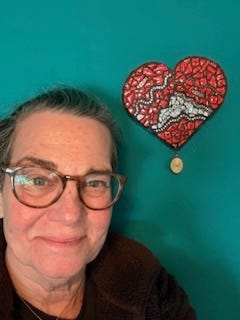
I was ready for this kick-ass class. I’d had a good night’s sleep and drank my coffee with a protein shake.
About 10 minutes into the class things fell apart. My head was foggy; my body felt sluggish doing movements I had easily done in other classes; the teacher’s voice seemed too loud; the music was irritating. Nothing was working.
Ahhh. I slowed down and lowered the springs. My nervous system was suggesting a different path.
I loved what came next.
I felt my breath guiding me. I felt my body melt into the movements.
I felt myself staying with curiosity instead of doing through pushing.
Feeling Through Fascia
How, you might be wondering, does this shift from doing to staying happen?
I first learned about fascia in a yoga class with my dear teacher, Steve Emmerman.
He asked us, at the beginning of class, to stand and do a forward fold. “Notice,” he said, “where you begin to feel tension and stop there. Don’t push beyond that point.”
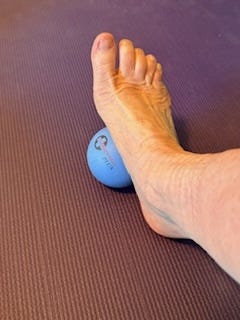
Then, he passed out some firm blue massage balls and asked us to stand with one hand against the wall gently massage the bottom of one foot, and then the other, from front to back and side to side.
Even after 50, I was a committed yoga student and quite advanced. I was surprised that I could only use the lightest pressure on my tender feet.
That’s all we did. It took minutes. Then Steve asked us to return to the center of the room and, once again, bend forward. I heard audible gasps around the room, including my own, as we noticed so much more ease and length in our forward folds.
That was my first “fascia feeling” moment. I now see that the brief self-massage moment was a moment of “staying.”
I felt my feet. But that’s not all.
My breath softened.
My nervous system quieted.
I felt my whole body, instead of trying to fix it.
That was a moment of staying.
Staying and Sensing
This brief introduction to fascia led me to seek out and study with Jill Miller, fascia and breath expert.
Fascia is a whole-body connective tissue that weaves through our muscles, ligaments, and tendons. It speaks to our nervous system as well.
When we stay in our bodies – sometimes called embodiment – we speak to our nervous systems and we can learn.
Do we need to
lighten the springs,
take a walk,
put aside our project until another day, or
roll our feet on some balls?
Experience Staying and Sensing
Would you like to roll a ball on your feet? You can use a tennis ball.
First, simply bend forward only until you feel a hint of tightness. Notice.
Place one hand on the wall and the ball under one bare foot.
Look ahead with a soft gaze. Be curious.
Roll everywhere on the sole of your feet – sideways, back and forth.
No pain. Play. Breathe softly. Relax.
And then, when you’ve rolled both feet, step away from the wall and do the forward bend.
Notice again.
This is where self-healing starts.
Please Comment Below
When you stand up after sitting, what does your body say to you?
Annmerle - Slowing down and lowering the springs. I love the sound of this and what a great phrase to get us to be curious not only about what does this mean, but what would it feel like to "do this" in a different way than sitting too much or moving too fast throughout our day in relation to our bodies.
It brings to mind slowing down, listening to our bodies and "leaning in" to what our bodies need below the surface of "everday living." And I believe you hit upon listening to our fascia if I have this?
I come from a place where I focus on the mind in conflict. What does one do when one wants to continue with the email and one wants to stop and remove oneself from the all day sitting. You, I think, hit upon stopping and spending some time below the surface of the mind - below our skin in relation to our fascia. Given that the mind and body are one I rather like what you are laying down. Healing related to slowing down and lowering the springs.